
How to Pick a Reliable Ski Instructor in Hokkaido, and What a Day Should Cost
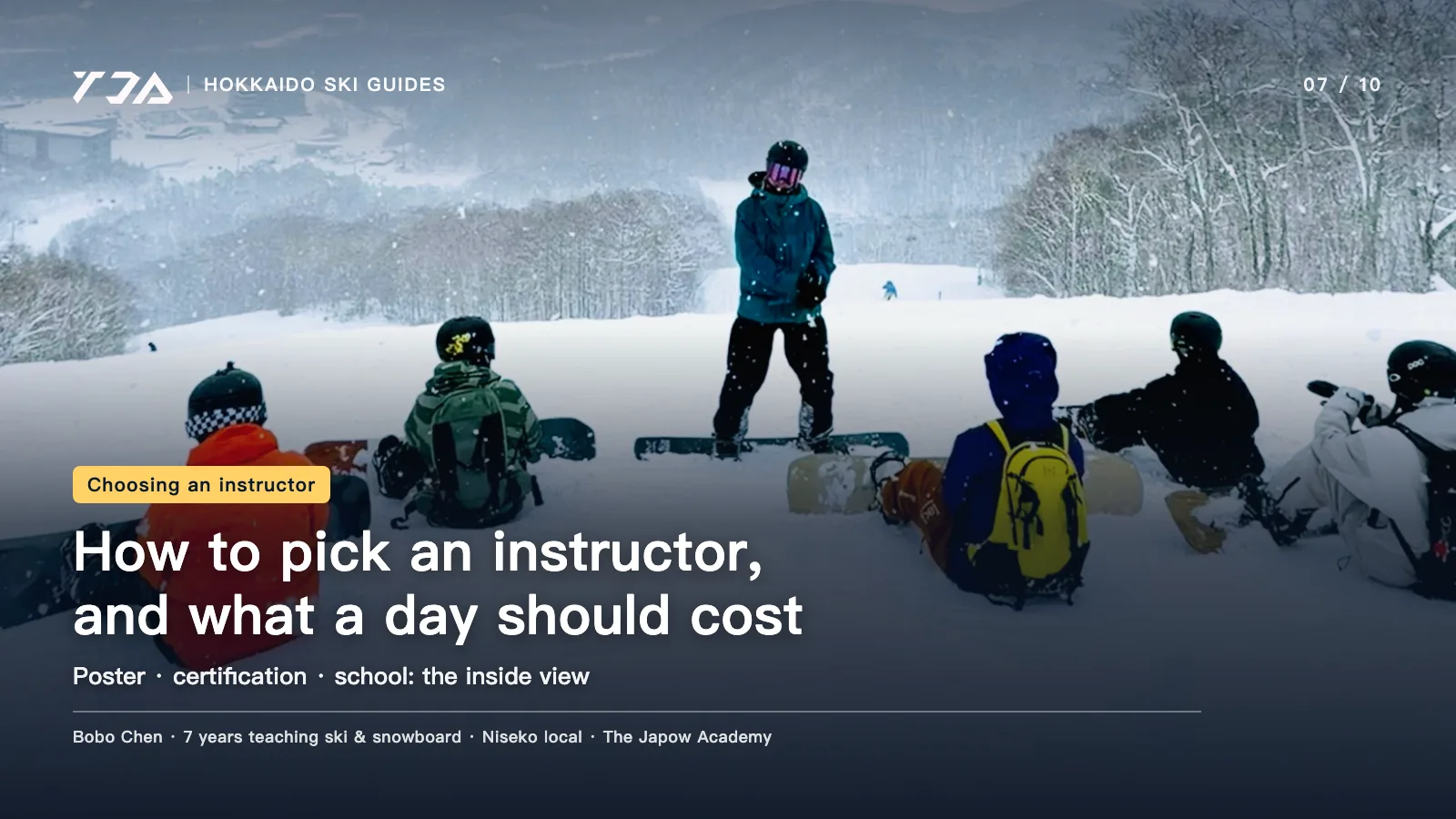
The previous article covered whether you need an instructor. This one answers the two questions everyone asks next: how do you tell a reliable instructor from an unreliable one, and what is a fair price for a day?
How to tell if an instructor is reliable
Three simple checks: look at the poster, look at the certification, look at the school.
The poster
An instructor’s poster is what they most want to show you. The design, the taste and the mood they’re going for say a lot about their attitude. It’s like meeting someone for the first time: you need a face before you can talk about values. Every one of our instructors has a poster on the team page, so start there.
The certification
The four mainstream international systems for skiing and snowboarding:
| Country | Ski | Snowboard |
|---|---|---|
| Canada | CSIA | CASI |
| New Zealand | NZSIA | SBINZ |
| USA | PSIA | AASI |
| UK | BASI (covers both) | BASI |
Levels run from 1 to 4, higher is better. A Level 1 can teach beginners without any problem. For intermediate coaching, look for Level 2 and above. These systems distil what each country’s best riders know, refined over decades, and their core is safety, fun and efficient, controlled progress. Technically, you don’t need to worry.
The best thing about systematic teaching is that it’s backwards compatible: beginners take a Level 1, intermediates a Level 2, future instructors a Level 3, each layer built on the last like blocks. You’ll never have a Level 3 telling you “what your Level 1 taught you was wrong, start again”.
Some people say “a certificate doesn’t mean they can teach”. I’d ignore that. Does an uncertified, self-invented technique teach better? Yes, some certified instructors explain less clearly than others, but someone willing to spend the money and time to certify, and keep certifying, has already shown their attitude towards teaching. A certificate guarantees the floor.
The school
Hokkaido is a battlefield, and competition is fierce. A school that wants to survive long term has to put reputation and customer experience first. You may not understand instructors, systems and technique, but the school does, and a school that wants to stay in business can’t afford to send you someone poor. Choosing a school you feel good about is your guarantee: if you’re genuinely unhappy, the school will switch your instructor rather than argue.
What’s a fair price?
The market rate for a private instructor in Hokkaido is roughly RMB 3,000 to 4,000 a day (about US$420 to 560). Anything well below that deserves a second look. Group lessons run about RMB 1,000 to 1,500 per person (US$140 to 210).
At our school, instructors average international Level 2 or above and all ride and teach both ski and snowboard. Full-day pricing varies by season and sits between RMB 3,000 and 3,800, which is mid-range for Hokkaido. See lesson prices.
Let’s do the maths on that price. Reaching Level 2 takes an instructor a great deal of money and time in practice, training and exams, and the pass rate is low, so resits are common. An instructor’s working year runs only from December to early April, under four months, and after you strip out the shoulder seasons and the days lost to gales, blizzards and fog, an average winter offers only 60 to 70 working days. In Hokkaido, the school’s overheads plus one instructor’s daily food, accommodation, transport, lift pass and insurance come to more than RMB 1,000 (US$140) a day. Add it up and it really isn’t expensive.
The ending
The money you spend on an instructor buys your time, not company on the slope. This winter’s trip may carry a whole year of anticipation, and we want you to spend it well and enjoy it.
The Japow Academy has fourteen instructors this season across Niseko Moiwa, Rusutsu and Kiroro, with free transfers to Rusutsu and Kiroro for guests staying in the Niseko area. Contact us and we’ll match you with an instructor until you’re happy.
- Next in the series: Where to stay in Niseko, the non ski-in hotels